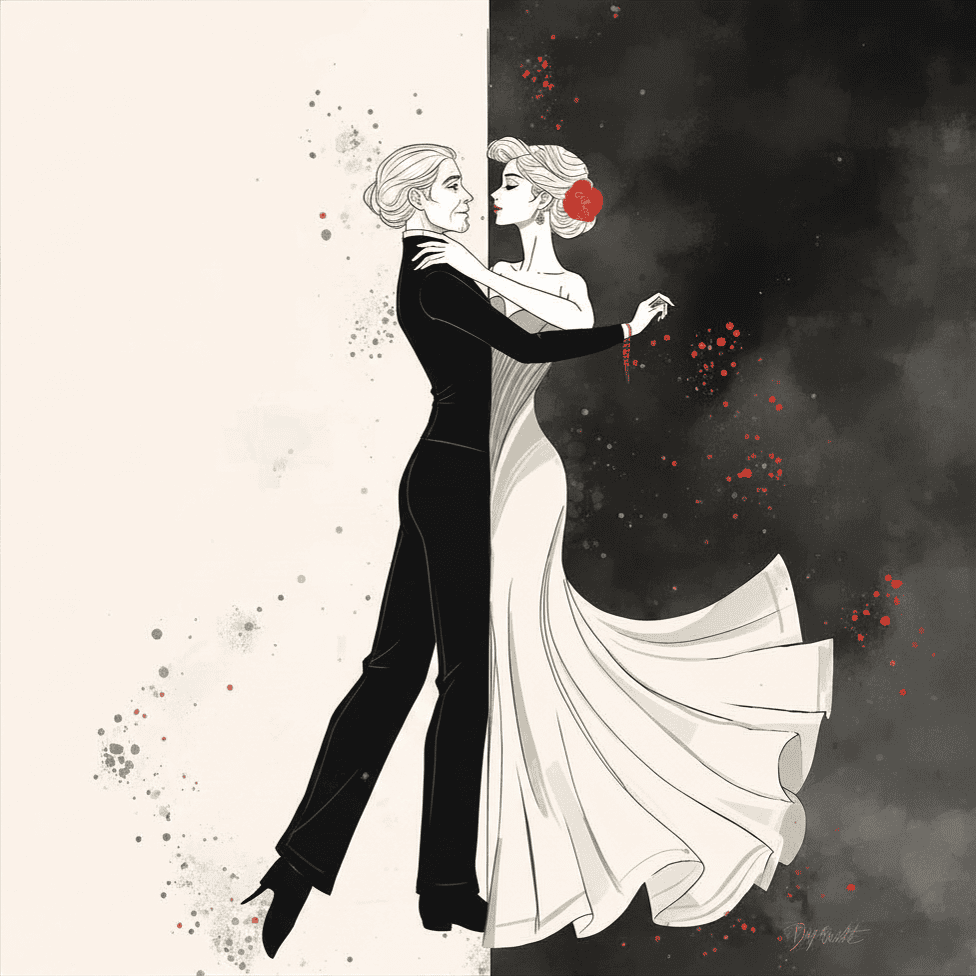
Or about the child in each of us, who never ages
No matter how old our ID card is, there is a child living inside each of us. A child who has waited to be seen, held, calmed when he was afraid, admired unconditionally. Sometimes he was, sometimes less so. This child does not age. At twenty, at fifty, at seventy, he is there, with the same needs. Most of the time, we end up loving him ourselves. Sometimes, just sometimes, we turn to someone else and ask him to hold us when we can’t do it alone. That is not weakness. It is one of the most human things we do.
This is where I think it’s worth starting when we talk about couples with a big age gap. Not from scandal, not from daddy issues, not from “age is just a number”. From this inner child of each one, who seeks a safe place in the other. Because, if we look closely, all couples do this, not just those with an age gap. The age gap just makes a dynamic that we all carry more visible anyway.
Two reflexes that stop us from seeing
The culture we live in oscillates between two reflexes, and neither really helps real people.
The first one says “age is just a number” and sweeps under the rug everything that happens between two people at different stages of life.
It’s a well-intentioned reflex, but it blocks important conversation. Yes, age is a number, but fertility, retirement, caring for sick parents, body rhythms, social energy, all are anchored in that number. To pretend it doesn’t matter is to not look together at the very things that will matter in the years to come.
The second, more recent reflex reduces everything to daddy issues, to the figure of the predatory male, to “he’s clearly taking advantage of her”.
It reduces one living person to a syndrome and another living person to a victim. It leaves no room for what happens between real people: encounters that involve need, choice, freedom, and sometimes traps, all at the same time. It’s an easy reflex to adopt, because it seems protective, but it invalidates the very people it claims to protect, and makes them hide their relationship instead of being able to watch it with friends and family.
Between these two reflexes, there is a third option, simpler and harder to sustain: let’s look. Let’s look at what each brings to the relationship, what they are looking for, what responds to that search, and what happens when two inner children, of the same symbolic age, meet in a couple that, on paper, has a twenty-year difference.
What does each bring to the scene?
The younger partner brings with him, among other things, a child who may have been waiting for a secure adult for a long time. A father who is present without being authoritarian. A mother who soothes without swallowing. A figure who says “I’m here, you don’t have to carry everything”. If there was no such adult at home, the inner child is left with the need. When he encounters in someone older a promise of stability, of calm, of permission to be vulnerable, the attraction is not pathological. It is an attempt at healing, often unconscious, but as legitimate as any other form of searching for home.
He also brings his own gifts: vitality, curiosity, intensity, a young body, fresh questions, enthusiasms not yet eroded by life. These are not just “benefits” for the other. They are his. In a healthy couple, they are recognized as such, not confiscated.
The older partner brings, in turn, a child who has not aged either. Perhaps a child who was given responsibility too early, who had to be mature when others were not, who carried families, jobs, responsibilities, and now, at a time when life has slowed down, feels the need to return to something fresh, alive, not burdensome. Or a child who has never felt wanted enough and who finds in the admiration of the other a form of oxygen that he had not had before. Or, simply, a child who has resources to share, tenderness that has not found its place, experience to give.
It also brings, of course, what mature age gives: stability, knowledge, patience, the ability to accommodate emotionally, peace gained over the years. These are real gifts. A couple that recognizes them as gifts, not as tools of power, has a good chance of not falling into the trap of rigid roles.
If we look closely, we will see something simple and true: the two inner children are the same symbolic age. Two children who have grown up not being seen enough, each in their own way, and who are looking for a safe place in the other where they can finally be held. This is not pathology. It is a human experience, shared by most couples, but in the case of an age difference in the couple it is seen more clearly.
When the scene works
There are couples with a big age gap that work well in the long run. What they have in common is not the disappearance of the difference, but a certain honesty about what is going on between them.
They both unashamedly acknowledge what they were looking for in each other. I’m not pretending that age didn’t matter, that experience didn’t matter, that youth didn’t matter. I’m naming things. A couple who can say, “You gave me the security I didn’t have, and I gave you back a joy you’d lost” has a much stronger story than one who insists, “We just loved each other, age had nothing to do with it.” Acknowledging the exchange doesn’t diminish the love. It anchors it.
The roles do not remain frozen. The child of the younger partner grows up, and the older partner accepts this growth. If at first one was the one who “knew” and the other was the one who “learned”, over time the position relaxes. The young person begins to have his own authority, and the mature one accepts, in turn, to ask, not to know, to be supported. The growth of one is not felt as a threat by the other, but as a confirmation that the relationship has room to change.
They talk about the real stuff. Each person’s life stage is brought up early: kids, retirement, caregiving, pace, health. The couple doesn’t avoid difficult conversations just because they’re uncomfortable. They carry them, as much as they can.
The social circle includes both generations. The younger person’s friends are welcome. The older person’s family is welcome. The couple does not retreat into a bubble from which only one partner can breathe.
Sexuality is transforming. What was initially a game of polarities (experienced and novice) becomes, over time, a meeting between two partners who know each other, who know their desires, who can both lead and be led.
When the dance freezes
There are, just as true, couples where the scene stiffens and the dancing stops. It’s not always dramatic, it’s not necessarily abusive, although sometimes it can be. More often than not, it’s just a scene that has stopped moving and that no one can change without losing something they feel they can’t afford to lose.
Some signs worth noting, either in ourselves or in someone we love:
Decisions are almost always made by the same person. Where we live, how we spend, who our friends are, what our pace of life is, everything is arranged without both voices having equal weight. The youngest one begins to find himself adapted, no longer knowing exactly what he would have wanted, if he had been asked.
One person’s growth stops. The younger partner stays at the level they met, not because they lack potential, but because real growth would upset the balance. Sometimes it’s something explicit (he doesn’t need a career, he doesn’t need to have his own income, his friends “are kids”). Other times it’s subtle, a subtle, repeated discouragement that builds up over the years.
Vulnerability can’t flow both ways. The older partner can never be the one who cries, the one who doesn’t know, the one who asks for help. If they step down, they feel like they’re losing their place. The younger partner, in turn, isn’t allowed to be an adult, because that would mean the other person isn’t as necessary anymore.
Sexuality remains stuck in its original form. Fifteen years into the relationship, the erotic dynamic is still that of the first encounter. One learns, the other is taught. The young man’s body has never been encountered as a whole adult.
The social circle has narrowed. Old friends have disappeared one by one, and the family of origin is kept at a distance. Whether this was an explicit choice by both of them is debatable. If it happened gradually, without the isolated one ever saying yes, it is worth looking more closely.
None of these signs, taken alone, means a relationship is unhealthy. They all appear, to varying degrees, in many couples, regardless of age. The question is not “do we have any of these signs?” but “are we able to talk about them together without becoming defensive?” The answer to the second question says more than the first.
From the ritual there in
The difference between a rigid scene and what couples therapists call a dance of secure attachment is not the disappearance of the age difference. The age remains. Something else changes: the roles cease to be fixed.
The turning point is the moment when each can say, without shame, what they were looking for in the other. “I was looking for the secure adult in you that I didn’t have. Part of what I felt at first was a desire to finally be held.” “I was looking for the vitality that I had lost in you. Part of what I felt at first was a desire to feel alive again.” This conversation moves the couple from a register in which the other is confused with who we need them to be, to a register in which they both know why they are there and can meet based on this knowledge, not in spite of it.
Once this conversation has taken place, the roles can relax. The youngest can sometimes be the one holding the space. The oldest can sometimes be the one asking. Who hosts and who is hosted no longer depends on how old each is, but on what the moment demands. This is the practical definition of adult reciprocity.
The illusion of salvation is also given up. No one can fix the other. The older partner is not obligated to make up for the childhood that was missed, and the younger partner is not obligated to heal the other’s loneliness. Each returns to their own healing work, and the relationship becomes the place where that work can safely happen, not the agent of it.
The child who sometimes needs
I’m going back to where I left off. Inside each of us is a child who never ages. A child who wants to be loved. Most of the time, we learn, slowly, to love it ourselves. We listen to it, we calm it, we take it where it needs to go, we stop it when it makes a bad choice. But sometimes, no matter how grown up we are, this child needs someone from the outside. Not forever. For a moment. For a while. For a lifetime, if he’s lucky.
Age-gap couples are no more or less than the rest: they are the stage on which two such children meet. One may have more wrinkles. The other has more energy. But the children inside are just as old and just as thirsty. That’s not a criticism. It’s actually one of the good news of adulthood: that there’s no point after which we’re not allowed to have needs.
What matters is not the age on the outside. What matters is whether, in time, each one also becomes the adult of their inner child, or remains stuck waiting for the other to always be the adult, endlessly. Healthy dance is born when both grow together, in the direction in which they can be, in turn, child and adult, held and the one who holds.
If you find yourself here, yourself, a loved one, a parent, a friend: that’s okay. It’s a form of love as human as any other. It has its pitfalls and it has its healings, like any other form. What matters is to see the scene and remain willing to renegotiate it when it gets stuck.
An age difference in a couple is neither a curse nor a simple biographical coincidence. It’s a scene.
reference
Francis-Tan, A., & Mialon, H. M. (2015). „A Diamond is Forever” and other fairy tales: The relationship between wedding expenses and marriage duration. Economic Inquiry, 53(4), 1919-1930.
Lee, W. S., & McKinnish, T. (2018). The marital satisfaction of differently aged couples. Journal of Population Economics, 31(2), 337-362.
Lehmiller, J. J., & Agnew, C. R. (2008). Commitment in age-gap heterosexual romantic relationships: A test of evolutionary and socio-cultural predictions. Psychology of Women Quarterly, 32(1), 74-82.
Lomotey, J. N. A. A. (2025). Age differences and emotional maturity: Age gaps’ influence on emotional maturity, conflict resolution, and relationship satisfaction. International Journal of Research and Innovation in Social Science, 9(10).
Johnson, S. M. (2019). Attachment theory in practice: Emotionally focused therapy with individuals, couples, and families. Guilford Press.
Simeone-DiFrancesco, C., Roediger, E., & Stevens, B. A. (2015). Schema therapy with couples: A practitioner’s guide to healing relationships. Wiley-Blackwell.